Leadership strain rarely starts at work. It starts when leaders carry invisible load at home and continue to operate as if nothing has changed.
A senior leader is navigating a parent’s cancer diagnosis while preparing for a board presentation. A founder is managing their child’s neurodivergence challenges while scaling a Series A business. An executive is dealing with their own perimenopause symptoms while leading a global team through restructuring.
The common thread: they’re still trying to maintain the same pace, the same standards, the same level of output. And they’re burning out quietly, wondering why everything feels harder than it used to.
When life is loud, leaders need a different prioritisation lens. Not urgency vs importance, but impact vs cost to energy.
The Problem with Traditional Prioritisation
The Eisenhower Matrix is a powerful tool. Urgent vs important. Do, decide, delegate, delete. It works well when you have consistent energy and stable capacity.
But when life is loud-when you’re carrying significant personal load alongside professional responsibility-the traditional framework breaks down. Because everything can feel urgent. Everything can feel important. And you don’t have the bandwidth to do it all.
Research on decision fatigue shows that every decision depletes a finite cognitive resource. When you’re already operating under high personal stress, your decision-making capacity is reduced before you even start the workday. The result: poor choices, reactive leadership, and a gradual erosion of both performance and wellbeing.
This is where sustainable leadership requires a different approach.
The Impact vs Energy Cost Framework
Instead of asking “Is this urgent or important?”, ask: “What impact does this create, and what does it cost me in energy?”
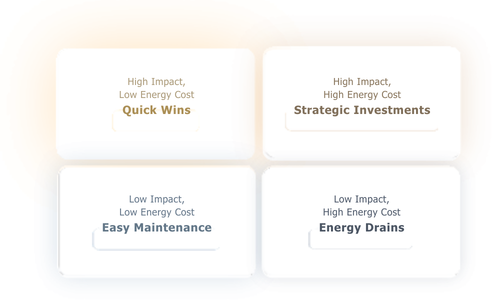
This is a simple 2×2 matrix with two axes:
– Vertical axis: Impact (High to Low)
– Horizontal axis: Energy Cost (Low to High)
This creates four quadrants:
1. High Impact, Low Energy Cost → Protect
These are your leverage activities. They move the needle without depleting you. Protect these ruthlessly. Schedule them first. Build your week around them.
Examples: A weekly 1-on-1 with your strongest team member that keeps them aligned and energised. A monthly investor update that takes 30 minutes but maintains confidence and clarity. A decision framework you’ve already built that you can reuse without reinventing.
2. High Impact, High Energy Cost → Limit & Batch
These activities matter, but they drain you. You can’t avoid them, but you can control when and how you engage with them.
Examples: Difficult performance conversations. Major strategic decisions. High-stakes client presentations.
The shift: Batch them. Don’t scatter them across the week. Schedule them when you have the most energy (typically early in the week, early in the day). Build in recovery time afterward.
3. Low Impact, Low Energy Cost → Automate or Keep Minimal
These are habits or routines that don’t cost much but also don’t move the needle significantly. Keep them light. Automate where possible.
Examples: Routine reporting that can be templated. Standard meeting updates. Administrative tasks that can be delegated or systemised.
4. Low Impact, High Energy Cost → Defer, Delegate, or Drop
This is where most leaders are bleeding energy without realising it. These activities feel necessary. They feel like you “should” be doing them. But they’re consuming disproportionate energy for minimal return.
Examples: Attending every meeting you’re invited to. Responding to every request immediately. Trying to maintain pre-crisis standards in areas that don’t actually matter right now.
The shift: Give yourself permission to let these go. Not forever. Just for now. While life is loud.
Real Example: A Leader Recalibrating Under Strain
A senior leader came to me burnt out. For years he’d operated at senior manager level. Now he was working two levels down, reporting to a toxic boss, staying put because the market was slow and income mattered.
Origin was the turning point.
We named the truth: “I am a bona fide leader temporarily in a junior role, choosing this as a bridge while I build my next chapter.”
That single reframe restored agency. As G. K. Chesterton wrote: “A dead thing can go with the stream, but only a living thing can go against it.” He chose to be living again.
Resilience came next.
Instead of chasing the perfect next role, we changed the internal game:
– One private scoreboard: Did I operate at my true level today?
– A toxic-day protocol to stop emotional bleed
– One weekly boundary that protected self-respect
The goal wasn’t to fix the environment. It was to stop letting it define him.
Then came Alignment.
We ran two tracks in parallel:
1. Survive with standards: stay professional without shrinking
2. Create the exit: build visible proof of his real level
The second track was the game-changer. Every week he had to create, not consume: a sharp case, a thoughtful reach-out, a public expression of his thinking. Not for anyone else’s approval. For his own scoreboard.
As James Clear puts it: “The more you create, the more powerful you become. The more you consume, the more powerful others become.”
When you can’t change your circumstances yet, change the game you’re playing inside them.
Two Questions to Recalibrate Your Week
When life is loud, these two questions create immediate clarity:
1. Which responsibilities deliver the highest impact for the lowest energy cost right now?
This isn’t about what’s most important in the abstract. It’s about what creates the most value with the resources you actually have available this week.
2. What are you continuing to do out of habit rather than necessity?
Most leaders are carrying forward commitments and standards from a time when they had more capacity. When life changes, your workload needs to change with it. What was essential six months ago might not be essential now.
One Action: Draw the 2×2 This Week
This week, take 15 minutes and draw a simple 2×2 matrix. Impact on one axis. Energy cost on the other.
Plot your major responsibilities and recurring commitments. Be honest about what actually drains you, even if it “shouldn’t.”
Then make one decision:
– Protect one High Impact, Low Energy activity by blocking time for it first.
– Defer, delegate, or drop one Low Impact, High Energy activity.
That’s it. One shift. One week.
Sustainable leadership doesn’t come from doing everything. It comes from recalibrating focus, boundaries, and expectations when life demands it.
Not everything that matters deserves your energy right now.
The Resilience You’re Building
This isn’t about lowering standards. It’s about protecting judgement.
When you allocate energy deliberately, you preserve your capacity to think clearly, make good decisions, and show up as the leader your team actually needs. When you try to maintain the same pace regardless of personal circumstances, you erode that capacity. Your decisions get worse. Your relationships suffer. And eventually, something breaks.
Research on resilience shows that the most effective leaders aren’t the ones who power through regardless. They’re the ones who recalibrate in real time. They notice when circumstances have changed. They adjust their approach. And they protect their capacity to lead well over the long term.
This is what resilience actually looks like in practice.
Leading through a difficult season? If you’re carrying invisible load and need to recalibrate without sacrificing effectiveness, the ORAlume Leadership Clarity Intensive helps you redesign your week around impact, not obligation.