
What ORA Sparks 1–9 Are Really About (And How to Use Them)
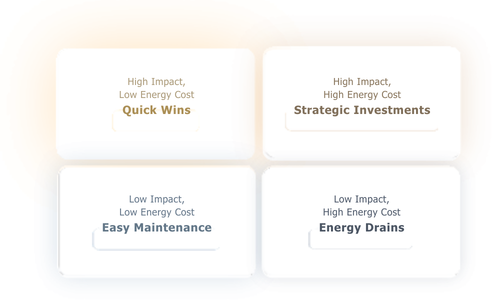
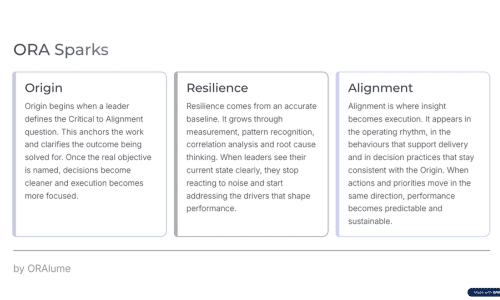
Since December 2025, nine ORA Sparks have been published on LinkedIn – short, structured reflections built on the same three‑part lens: Origin, Resilience, Alignment. This article is the map: what they are really about, how they connect, and how to use them as a practical leadership tool. The structure behind every Spark ORA stands for Origin, Resilience, Alignment. It is the operating framework used across all ORAlume work, from EQ‑i 2.0 debriefs to fractional CFO engagements to coaching. Origin is the diagnostic move. What is really going on here? What pattern, assumption, or emotional driver is underneath the surface problem? Resilience is the honest reckoning. Given what is actually true, how do you stay functional, clear, and choiceful under pressure – rather than reactive, avoidant, or running on old instructions? Alignment is the performance move. How do you get your decisions, behaviours, relationships, and capital pointing in the same direction? Not balance. Alignment. Each Spark applies this three‑part lens to one specific leadership pressure. The format is short by design. The point is not to explain everything, but to name the thing clearly enough that you can see it in your own week. The nine Sparks, mapped Spark 1: When External Validation Disappears December 2025 The first Spark came out of the early ORAlume build – interim CEO rejections, silence from NHS NED applications, and the moment when external confirmation simply stops arriving. The Origin question was: what do I actually control right now? At the Resilience level, the move was reallocation – stop waiting for permission and put energy into building instead. The Alignment principle was that clarity follows movement, not the other way around. Waiting for certainty before acting is a pattern that looks like prudence but often functions as avoidance. This is relevant for anyone in a career transition, a slow market, or a period where external metrics are not reflecting the internal work being done. Spark 2: Leading When Life Is Loud December 2025 The second Spark introduced the impact versus energy cost lens as an alternative to urgency versus importance. The traditional Eisenhower Matrix breaks down when personal load is high. When everything feels urgent and important simultaneously, decision fatigue accelerates. The shift is to ask a different question: what creates the most impact for the lowest energy cost right now? Protect those activities. Defer, delegate, or drop everything else – not permanently, but for this season. This Spark generated the most personal responses in the series. The pattern of leaders carrying invisible load while maintaining full output is more common than most organisations acknowledge. Spark 3: Rhythm Turns Clarity into Performance January 2026 This Spark addressed a pattern that shows up early in any build – the drift from meaningful output into endless refinement. Ideas do not compound on their own. Rhythm does. The Origin here was the recognition that energy, without a delivery rhythm, leaks into tweaking and rebuilding. At the Resilience level, the move was to identify one thing to ship every week, even when confidence is low. The Alignment principle was that rhythm is not hustle. It is the structural condition for sustained performance. Spark 4: Change the Game Before You Change the Job January 2026 Spark 4 came from a client conversation – a senior leader operating below his real level, held in place by a slow market and income pressure. The Origin question was not how to exit, but how to stay without shrinking. The reframe restored agency: “I am a bona fide leader, temporarily in a junior role, choosing this as a bridge.” The Alignment structure created two parallel tracks – survive with standards, and build visible proof of real‑level work through weekly creation rather than consumption. Spark 5: When Your Calendar Quietly Becomes Your Risk Register February 2026 Before numbers wobble, the calendar does. A diary is not a passive record. It is a live forecast of where attention, energy, and decision‑making capacity are being spent. When thinking time disappears, difficult conversations are delayed, and strategy is replaced by reactive meetings – the risk register is already moving. The practical move: actively manage the diary. Lock in high‑impact thinking time. Remove low‑value meetings. Schedule difficult conversations early. Spark 6: When Busyness Replaces Progress February 2026 Leaders tend to feel busiest just before momentum stalls. The Origin recognition is that busyness often appears when a decision is being avoided. At the Alignment level, the move is a short audit: where did you add work instead of removing an obstacle? Ask for more information instead of making a call? Refine internally instead of testing externally? Progress usually requires one uncomfortable move. Spark 7: The Loneliest Generation Is Entering Leadership Pipelines March 2026 This Spark brought in the wider data – generational shifts, job displacement, and rising workplace loneliness. This is not primarily a generational debate. It is a leadership execution problem. Loneliness erodes confidence, decision quality, and willingness to take responsible risk. It shows up before performance data does. The Alignment argument: connection is not cultural. It is operational. Leaders reduce it by making decision‑making visible, pairing younger professionals with real work, and creating small trusted circles where questions are safe. Spark 8: Most People Use Learning to Avoid Selling March 2026 This Spark came from the tension between professional development and business development. When time is limited, most people default to learning – it feels productive and low‑risk. The Origin question: is this learning translating into outcomes? The Resilience recognition: learning without application drifts away from impact. The Alignment principle: integrate learning into live environments. Treat capability‑building as a commercial lever, not a separate track. Spark 9: When the Structure Matters More Than the Multiple April 2026 The final Spark in this first chapter addressed deal‑making, but the principle extends far beyond M&A. The Origin: a deal can look strong on headline metrics while structural reality tells a different story. The Resilience insight: attractive headlines often hide misalignment in control, incentives, and time horizons. The Alignment principle
What ORA Sparks 1–9 Are Really About (And How to Use Them) Read More »