
Emotional Intelligence

Resilient Leadership When the World Is Loud: What Davos Gets Right and What Leaders Need Next

Every global forum now talks about resilience, but for most leaders it still feels abstract. You hear about shocks, polycrises and the need to “build resilience”, while you are simply trying to keep a team focused, a board aligned and a business funded. This article is about turning that big-picture resilience agenda into something you can actually practice. 1. Why everyone is suddenly talking about resilience In the last few years, global conversations have shifted from efficiency and optimisation to resilience and adaptability. Supply chain shocks, geopolitical risk, climate events and rapid shifts in technology have made it clear that disruption is not an exception; it is now the operating environment. Boards and investors are asking new questions: How quickly can we adapt? How well do we absorb shock without losing trust, talent or momentum? At the same time, leaders are carrying more personal load than ever: caring responsibilities, health issues, the emotional impact of constant uncertainty, and the pressure to have a considered opinion on everything that happens in the world. Resilience is no longer a “nice to have” leadership trait. It is the bridge between global volatility and everyday decisions about people, capital and priorities. The World Economic Forum’s Future of Jobs Report 2025 reflects this shift. Employers now rank resilience, flexibility and agility, leadership and social influence, motivation and self-awareness and other human skills alongside analytical thinking as top core skills for the workforce. You can read more in the skills outlook section of the report here . 2. What resilience actually looks like in a leader Resilience is often mistaken for stamina or grit, the ability to just keep going. In practice, resilient leaders do three different things: – They absorb shocks without becoming emotionally flooded. They can feel pressure, but it does not spill unfiltered into their decision making or relationships. – They adapt behaviour and strategy when reality changes, rather than clinging to the original plan because so much has already been invested in it. – They align others around the new reality, sustaining trust and clarity even when the news is difficult. Those behaviours are not mysterious. They sit on top of very specific emotional intelligence capabilities that can be measured and developed. 3. The EQ-i 2.0 subscales that build resilience Within the EQ-i 2.0 framework, several subscales directly underpin resilient leadership: Stress Tolerance – your ability to remain functional and composed under pressure. Leaders with higher Stress Tolerance are better able to keep thinking clearly while others are overwhelmed. Flexibility – how easily you can shift your thinking, plans or behaviour when circumstances change. Flexibility is what lets you pivot without losing your core direction. Optimism – your capacity to hold a realistic belief that things can improve. This is what keeps teams engaged and willing to try again after setbacks. Reality Testing – your ability to see things as they are, not just as you hope or fear them to be. Without this, optimism turns into denial. Emotional Self-Awareness – how quickly you can recognise what you are feeling and how it is influencing you in the moment. The most resilient leaders are not the ones who score perfectly on each of these, but those who understand their pattern—for example high Optimism paired with lower Reality Testing—and design habits and support around it. 4. ORA: translating global resilience into your week The ORA framework turns this into practice: Origin – see what is really there. Benchmark yourself against leadership norms with the EQ-i 2.0 assessment. Instead of vague stories like “I am good under pressure”, you get data on how you actually show up. Resilience – work with how you operate under pressure. Move from scores to behaviours. For example, if Stress Tolerance is strong but Flexibility is lower, you may cope well in crisis but struggle to change course quickly. You design specific practices, like the Impact vs Energy Cost framework or structured recovery rituals, that match your profile. Alignment – make decisions, money and relationships pull in the same direction. Resilience is not just about how you feel; it is about how you allocate capital, attention and trust. This is where you connect EQ patterns to things like runway decisions, hiring tempo and how you communicate risk to your board or team. Seen this way, resilience stops being a slogan and becomes a pattern you can observe and influence. 5. Three resilience patterns I see most often Here are three recurring patterns in senior leaders and founders, and what to work on: Calm but rigid These leaders stay composed in a crisis but hold tightly to the original plan. Stress Tolerance is high; Flexibility is lower. The work is to build structured “pause and rethink” moments where new data is genuinely allowed to change the plan, rather than simply being rationalised away. Flexible but flooded Others can pivot easily and generate options, but feel emotionally overwhelmed when stakes rise. Flexibility is strong; Stress Tolerance and Emotional Self-Awareness may be lower. Here you focus on noticing early physical and emotional cues, simplifying decision load and building small containment rituals before big conversations. Optimistic but ungrounded A third group radiates hope and possibility, which is crucial for engagement, but under-weights risk. Optimism is high; Reality Testing lags. The shift is to institutionalise good questions: “What has to be true for this to work?”, “What would we see first if this were going wrong?”, and to ensure at least one trusted voice in the room is explicitly tasked with stress-testing assumptions. Each pattern is workable once you can see it. The risk lies in leading on autopilot, believing you are “being resilient”, when in reality your pattern is quietly adding fragility. 6. Building resilience when life is loud Global volatility is not going away. Neither is the personal load many leaders are carrying. So the practical question becomes: how do you build resilience when your life is already full? A few starting moves: Resilient leadership is not about being invulnerable. It
Resilient Leadership When the World Is Loud: What Davos Gets Right and What Leaders Need Next Read More »

Leading When Life Is Loud: The Impact vs Energy Cost Framework

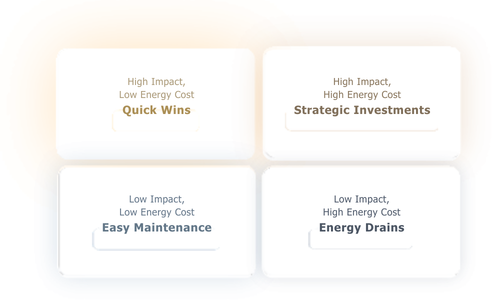
Leadership strain rarely starts at work. It starts when leaders carry invisible load at home and continue to operate as if nothing has changed. A senior leader is navigating a parent’s cancer diagnosis while preparing for a board presentation. A founder is managing their child’s neurodivergence challenges while scaling a Series A business. An executive is dealing with their own perimenopause symptoms while leading a global team through restructuring. The common thread: they’re still trying to maintain the same pace, the same standards, the same level of output. And they’re burning out quietly, wondering why everything feels harder than it used to. When life is loud, leaders need a different prioritisation lens. Not urgency vs importance, but impact vs cost to energy. The Problem with Traditional Prioritisation The Eisenhower Matrix is a powerful tool. Urgent vs important. Do, decide, delegate, delete. It works well when you have consistent energy and stable capacity. But when life is loud-when you’re carrying significant personal load alongside professional responsibility-the traditional framework breaks down. Because everything can feel urgent. Everything can feel important. And you don’t have the bandwidth to do it all. Research on decision fatigue shows that every decision depletes a finite cognitive resource. When you’re already operating under high personal stress, your decision-making capacity is reduced before you even start the workday. The result: poor choices, reactive leadership, and a gradual erosion of both performance and wellbeing. This is where sustainable leadership requires a different approach. The Impact vs Energy Cost Framework Instead of asking “Is this urgent or important?”, ask: “What impact does this create, and what does it cost me in energy?” This is a simple 2×2 matrix with two axes: – Vertical axis: Impact (High to Low) – Horizontal axis: Energy Cost (Low to High) This creates four quadrants: 1. High Impact, Low Energy Cost → Protect These are your leverage activities. They move the needle without depleting you. Protect these ruthlessly. Schedule them first. Build your week around them. Examples: A weekly 1-on-1 with your strongest team member that keeps them aligned and energised. A monthly investor update that takes 30 minutes but maintains confidence and clarity. A decision framework you’ve already built that you can reuse without reinventing. 2. High Impact, High Energy Cost → Limit & Batch These activities matter, but they drain you. You can’t avoid them, but you can control when and how you engage with them. Examples: Difficult performance conversations. Major strategic decisions. High-stakes client presentations. The shift: Batch them. Don’t scatter them across the week. Schedule them when you have the most energy (typically early in the week, early in the day). Build in recovery time afterward. 3. Low Impact, Low Energy Cost → Automate or Keep Minimal These are habits or routines that don’t cost much but also don’t move the needle significantly. Keep them light. Automate where possible. Examples: Routine reporting that can be templated. Standard meeting updates. Administrative tasks that can be delegated or systemised. 4. Low Impact, High Energy Cost → Defer, Delegate, or Drop This is where most leaders are bleeding energy without realising it. These activities feel necessary. They feel like you “should” be doing them. But they’re consuming disproportionate energy for minimal return. Examples: Attending every meeting you’re invited to. Responding to every request immediately. Trying to maintain pre-crisis standards in areas that don’t actually matter right now. The shift: Give yourself permission to let these go. Not forever. Just for now. While life is loud. Real Example: A Leader Recalibrating Under Strain A senior leader came to me burnt out. For years he’d operated at senior manager level. Now he was working two levels down, reporting to a toxic boss, staying put because the market was slow and income mattered. Origin was the turning point. We named the truth: “I am a bona fide leader temporarily in a junior role, choosing this as a bridge while I build my next chapter.” That single reframe restored agency. As G. K. Chesterton wrote: “A dead thing can go with the stream, but only a living thing can go against it.” He chose to be living again. Resilience came next. Instead of chasing the perfect next role, we changed the internal game: – One private scoreboard: Did I operate at my true level today? – A toxic-day protocol to stop emotional bleed – One weekly boundary that protected self-respect The goal wasn’t to fix the environment. It was to stop letting it define him. Then came Alignment. We ran two tracks in parallel: 1. Survive with standards: stay professional without shrinking 2. Create the exit: build visible proof of his real level The second track was the game-changer. Every week he had to create, not consume: a sharp case, a thoughtful reach-out, a public expression of his thinking. Not for anyone else’s approval. For his own scoreboard. As James Clear puts it: “The more you create, the more powerful you become. The more you consume, the more powerful others become.” When you can’t change your circumstances yet, change the game you’re playing inside them. Two Questions to Recalibrate Your Week When life is loud, these two questions create immediate clarity: 1. Which responsibilities deliver the highest impact for the lowest energy cost right now? This isn’t about what’s most important in the abstract. It’s about what creates the most value with the resources you actually have available this week. 2. What are you continuing to do out of habit rather than necessity? Most leaders are carrying forward commitments and standards from a time when they had more capacity. When life changes, your workload needs to change with it. What was essential six months ago might not be essential now. One Action: Draw the 2×2 This Week This week, take 15 minutes and draw a simple 2×2 matrix. Impact on one axis. Energy cost on the other. Plot your major responsibilities and recurring commitments. Be honest about what actually drains you, even if it “shouldn’t.” Then make

Leading When Life Is Loud: The Impact vs Energy Cost Framework Read More »

The Integration Advantage: Why Founders Need Coaches Who Understand Both Numbers and Nuance

A founder came to me six months into working with a business coach who was excellent at mindset work and vision clarity. “I feel inspired after every session,” she said. “But my cash runway hasn’t changed. My board narrative is still unclear. And I still don’t know whether to hire or wait.” Another founder had been working with a fractional CFO who cleaned up the financials beautifully. “The dashboards are perfect,” he told me. “But I’m making the same reactive decisions under pressure. My team still doesn’t trust my judgment. And I’m exhausted.” Both were getting value. Neither was getting integration. This pattern shows up repeatedly: founders receive either emotional intelligence work that doesn’t translate to execution, or operational discipline that doesn’t account for the human dynamics shaping every major decision. The question isn’t whether you need coaching or financial rigour. It’s whether you’re getting both in a way that actually compounds. The Data on Coaching: Signal vs Noise When founders tell me “everyone’s a coach now,” I understand the frustration. LinkedIn shows millions of profiles with “coach” in the headline. It feels saturated. The actual data tells a different story. There are roughly 3.6 billion people employed globally (World Bank/ILO). Industry research estimates only around 123,000 professional coach practitioners worldwide – roughly 1 per 30,000 employed people (ICF Global Coaching Study, 2025). The global coaching industry generated an estimated $5.34 billion USD in revenue over the past year, and demand is rising. So coaching isn’t saturated. What’s happened is the label now spans an enormous range from people exploring coaching skills to practitioners anchored in rigorous standards, supervision, and measurable outcomes. In an unregulated profession, standards become the signal. This matters because founders navigating growth inflections, board dynamics, or hiring decisions need more than motivation. They need coaches with: The question isn’t “Is this person calling themselves a coach?” It’s “Do they bring standards that match the complexity of what I’m navigating?” What’s Different About Experienced Founders At the same time, there’s been a significant shift in the founder landscape. “Founder” has become one of the fastest-growing job titles on LinkedIn, with the number of US professionals using the title up 69% year on year and nearly tripled since 2022. In the UK, nearly half of self-employed workers are over 50, and this group has grown 18% in the last decade. Solo self-employed workers contributed around £366 billion to the UK economy in 2024 (ONS data, Archimedia analysis). What’s distinct about this cohort is not just their age, but their approach: They’re building for retention, not just acquisition. The businesses that work are grounded in repeat clients, referrals, and sustainable economics, not pitch decks optimized for VC attention. They’re solving real problems now. These aren’t founders disappearing into product development for three years. They’re serving clients today, often in areas where 20+ years of experience gives them genuine market credibility. They’re operating with purpose. Many are channelling decades of hard-won expertise into work that honours the mentors, communities, or legacies that shaped them, building businesses that matter personally, not just financially. They value sustainable pace. They’re modelling that it’s possible to build around your life, not sacrifice your life to build. To be ambitious without burning out. To honour what you’ve learned without recreating the cultures that exhausted you. This isn’t “lifestyle business” as a dismissive label. It’s strategic sustainability. But here’s where it gets interesting: These founders still face the same fundamental challenges every founder faces – cash discipline, decision-making under pressure, hiring, pricing, board dynamics, and managing their own stress patterns when stakes are high. The difference is they often have less tolerance for advice that’s purely theoretical, and more need for integration between what they know intellectually and how they actually show up when pressure hits. The Integration Framework: Where Emotional Intelligence Meets Financial Discipline The pattern that creates the most value isn’t either/or. It’s both/and delivered in a way that actually compounds. Here’s what integration looks like in practice, mapped through three critical dimensions: 1. Origin: Leadership Diagnostics That Inform Financial Decisions The gap: Many founders know their numbers but don’t understand the emotional patterns shaping their interpretation of those numbers. What integration looks like: Using EQ-i 2.0 to surface patterns like: Then connecting those patterns directly to specific financial decisions: “Here’s where your EQ profile is showing up in your P&L, your hiring plan, and your board narrative. Let’s recalibrate.” Real example: A founder with strong Optimism but lower Reality Testing kept drifting into ambitious hiring plans the cash flow couldn’t support. The EQ-i debrief didn’t just identify the pattern, it created decision criteria that balanced possibility with runway math. Result: a staged hiring approach and a clearer, more credible board story. 2. Resilience: Building Capacity Under Pressure The gap: Founders often treat stress as something to power through rather than a variable that degrades decision quality. What integration looks like: Recognizing that resilience isn’t just mindset, it’s measurable through subscales like Stress Tolerance, Flexibility, and Impulse Control. Then connecting those patterns to: Real example: A leadership team showed misaligned Stress Tolerance and Impulse Control, leading to reactive decisions when quarterly targets were at risk. Group coaching on stress rituals, meeting design, and pre-commitment to decision frameworks stabilized execution before team fractures became permanent. 3. Alignment: Strategy Execution That Accounts for Human Dynamics The gap: Perfect financial models that assume rational actors, when real execution depends on trust, communication, and accountability. What integration looks like: Real example: A founder struggling with collections realized the issue wasn’t the invoicing system, it was his discomfort with Assertiveness in client conversations. Addressing the EQ pattern (through targeted coaching) improved cash conversion faster than any process change could have. What This Looks Like in Practice Integration happens when emotional intelligence work and operational discipline inform each other continuously, not sequentially. It’s not: It is: The best outcomes happen when founders work with practitioners who can move fluidly between “What does your cash position actually support?” and “What

The Integration Advantage: Why Founders Need Coaches Who Understand Both Numbers and Nuance Read More »

Most Money Mistakes Are Emotional: How to Spot Stress, Envy, and Ego Before They Cost You

Most leaders don’t get into financial trouble because they can’t do the numbers. They get there because unspoken feelings are quietly driving their choices about jobs, investments, and business growth. And those feelings show up in predictable patterns. Stress looks like panic-buying courses, consultants, or products to soothe anxiety instead of solving a real problem. Envy looks like upgrading homes, cars, or holidays to match peers, not because life truly improves. Fear looks like sitting on too much cash or never investing because the idea of loss feels unbearable. Shame looks like avoiding statements or ignoring debt, which only compounds the damage over time. Ego looks like chasing status purchases or “hero” investments instead of boring, consistent growth. Here’s the dangerous part: You can be highly intelligent. Highly qualified. Highly successful. And still make expensive decisions for emotional reasons. The Research: Why Smart People Make Costly Emotional Decisions Behavioural economics has spent decades documenting this pattern. Daniel Kahneman’s work on cognitive biases showed that even experts make systematically irrational decisions when emotions are involved. Loss aversion, anchoring, confirmation bias – these aren’t thinking errors. They’re emotional responses dressed up as logic. In financial contexts, the pattern is even clearer. A study published in the Journal of Behavioral Finance found that investors who scored higher on emotional awareness made significantly better portfolio decisions and experienced lower regret after market downturns. The difference wasn’t in their financial knowledge. It was in their ability to notice when emotion was influencing their choices. This is where emotional intelligence stops being abstract and becomes measurable leadership capability. How Emotional Patterns Drive Financial Decisions The EQ-i 2.0 framework measures 15 specific emotional intelligence subscales. Several of these directly predict financial decision quality, particularly under pressure. Reality Testing: Seeing what’s actually true, not what you wish or fear When Reality Testing is low, you’re vulnerable to fantasy growth projections, over-optimistic hiring plans, or investments that look good on paper but ignore actual market conditions. You see the opportunity but miss the risk. A founder I worked with had high Optimism paired with lower Reality Testing. Every quarterly plan assumed best-case scenarios. Revenue projections were aggressive. Hiring timelines assumed perfect execution. The team kept missing targets, not because they weren’t capable, but because the plan was never grounded in reality. The shift: Rebalance decision criteria. Introduce “what has to be true for this to work?” as a standing question in planning sessions. Stage hiring based on actual revenue milestones, not projected ones. The result: clearer board narrative, better cash discipline, and a team that could actually deliver what was promised. Impulse Control: The discipline to pause before acting Low Impulse Control shows up as reactive financial decisions. Panic-selling during market volatility. Buying a course or hiring a consultant because everyone else is. Chasing the latest investment trend without doing due diligence. High Impulse Control gives you the space to separate the feeling from the decision. You notice the anxiety. You acknowledge it. Then you assess whether the action you’re considering actually solves the problem or just soothes the discomfort. Emotional Self-Awareness: Knowing what you’re feeling in the moment If you can’t name the emotion, you can’t question whether it should be driving the decision. Emotional Self-Awareness is the foundational skill that makes everything else possible. A senior leader I coached had strong technical skills and a clear strategic mind. But during our EQ-i debrief, Emotional Self-Awareness came back lower than expected. When I asked how he knew when he was stressed, he paused. “I don’t really think about it. I just keep going.” That pattern showed up in his financial decisions too. When stress was high, spending increased – on tools, on people, on anything that felt like progress. But the underlying anxiety never got addressed. The spending didn’t solve the problem. It just created new ones. The shift: Build a stress recognition ritual. At the end of each week, ask: “What did I spend money on this week? What was I feeling when I made that decision?” That simple practice created a feedback loop. Within a month, reactive spending dropped. Decision quality improved. The Five Emotional Drivers of Money Mistakes Here’s how specific emotions map to financial patterns, and which EQ-i subscales can help you intervene earlier: 1. Stress → Panic Buying You buy courses, hire consultants, or invest in tools to soothe anxiety rather than solve the actual problem. The purchase feels like progress, but the underlying issue remains. EQ-i subscales: Stress Tolerance, Impulse Control, Reality Testing The shift: Before any stress-driven purchase, ask: “What problem am I actually trying to solve? Will this purchase solve it, or just make me feel better temporarily?” 2. Envy → Lifestyle Creep You upgrade your home, car, or holidays to match peers. The external markers of success become the goal, not the lived experience of a life that actually feels good. EQ-i subscales: Self-Regard, Independence, Emotional Self-Awareness The shift: Define success on your own terms. Notice when you’re making decisions to impress others rather than align with your actual values. 3. Fear → Cash Hoarding You sit on too much cash or avoid investing because the idea of loss feels unbearable. The capital sits idle. Opportunity cost compounds. EQ-i subscales: Optimism, Flexibility, Reality Testing The shift: Distinguish between prudent risk management and paralysis. Ask: “What’s the actual worst case, and could I handle it?” 4. Shame → Statement Avoidance You avoid looking at bank statements, ignore debt, or delay difficult financial conversations. The avoidance compounds the damage over time. EQ-i subscales: Emotional Self-Awareness, Assertiveness, Problem Solving The shift: Name the shame. Bring it into the light. Then build a simple ritual: open the statement, review it, make one small decision to improve the situation. 5. Ego → Status Investments You chase “hero” investments or status purchases instead of boring, consistent growth. The narrative matters more than the return. EQ-i subscales: Self-Regard, Reality Testing, Independence The shift: Separate identity from investment. Ask: “Would I make this decision if no

Most Money Mistakes Are Emotional: How to Spot Stress, Envy, and Ego Before They Cost You Read More »

The Leadership MRI: Why EQ-i 2.0 Assessment Is Built for Development, Not Just Diagnosis

A leadership team once described their two co-heads as “she’s the empath” and “he’s the tough one.” That story shaped how they were treated, how roles were assigned, and what was expected from each of them. Their EQ-i 2.0 profiles told a very different story. Her highest strengths were Reality Testing and Problem Solving. His standout strengths were Interpersonal Relationships and Emotional Expression. The so-called “tough one” was often the first to notice who was struggling. The so-called “empath” was quietly stress-testing big decisions. When the subscale results were shared, the conversation shifted. From gender stereotypes to “how do we design roles around actual strengths?” Both leaders walked away with clearer language, permission to lead authentically, and better role alignment. This is why emotional intelligence diagnostics matter. Not to label people, but to free them to lead well. Why Emotional Intelligence Assessment Matters Now Technical skills now have a brutally short shelf life. Skills that once lasted a decade can feel outdated in just a few years. Yet many organisations still promote on IQ, pedigree and technical capability first, with emotional intelligence treated as an afterthought. What the research shows is that emotional intelligence is not one vague or fluffy idea. It is a family of well-tested assessments that reliably predict leadership performance, resilience and culture. The data is clear. Leaders with high emotional intelligence earn around $29,000 more per year than those with low EI (TalentSmart research). Companies that prioritise EI are 22 times more likely to perform at higher levels (Six Seconds, Organisational Vitality Study). By 2030, nearly 40% of core job skills will change, with leadership, empathy, social influence, and active listening among the most critical capabilities (World Economic Forum, Future of Jobs Report 2023). These aren’t soft skills. They’re performance metrics. Three Frameworks, Three Different Questions There are three established emotional intelligence frameworks used in large organisations and leadership programmes worldwide. All three are research-backed. They simply answer different questions. MSCEIT (Mayer-Salovey-Caruso Emotional Intelligence Test): The Lab Test “You can read more about the MSCEIT here.” MSCEIT measures how well you can solve emotion-related problems under test conditions. It’s ability-based, similar to an IQ-style assessment. You’re presented with scenarios and measured on how accurately you perceive, use, understand, and manage emotions in those scenarios. This is valuable if you want to know your baseline emotional reasoning ability in a controlled environment. ESCI (Emotional and Social Competency Inventory): The 360 Mirror “You can read more about the ESCI here.” ESCI, developed by Daniel Goleman and Richard Boyatzis, is often used as a 360-degree assessment. It shows how others experience your emotional and social competencies in real workplace relationships. This is valuable if you want to understand the gap between your intent and your impact on others. EQ-i 2.0 (Emotional Quotient Inventory 2.0): The Leadership MRI “You can read more about EQ-i 2.0 here.” EQ-i 2.0 measures how you typically show up across 5 core composites and 15 emotional intelligence subscales. Unlike personality tests that tell you who you are, EQ-i 2.0 measures what you can develop. These are learnable capabilities that improve with awareness and practice. What makes EQ-i 2.0 distinctive is that it combines a deep self-report profile with EQ 360, allowing leaders to see the gap between how they experience themselves and how others experience their leadership. It turns emotional intelligence into a practical development roadmap, not a score that sits in a drawer. The Five Core Composites of EQ-i 2.0 Each composite represents a cluster of related emotional and social skills. Together, they form a comprehensive map of how you lead. Self-Perception: How clearly you see yourself Self-Expression: How you communicate and act Interpersonal: How you connect and influence Decision-Making: How you solve problems under pressure Stress Management: How you stay calm and resilient These 15 subscales can be measured, tracked, and developed. That’s what makes EQ-i 2.0 particularly useful for leaders who want to improve, not just understand. Real Examples of EQ-i 2.0 in Leadership Contexts Founder: Double Runway Pressure A founder with high Optimism but lower Reality Testing kept drifting into plans the organisation couldn’t absorb. The EQ-i debrief rebalanced decision criteria. The result: a staged hiring plan and a clearer board narrative. Senior Leader: Empathy Slowed Execution A senior leader had strong Empathy and Assertiveness but a cautious decision pace. The shift: link people insight to process clarity. Empathy informs decisions, but doesn’t govern them. Forum efficiency improved immediately. Leadership Team: Pre-Fracture Signals A leadership team showed misaligned Stress Tolerance and Impulse Control, leading to reactive decisions under pressure. Team coaching on stress rituals, meeting design, and difficult conversations stabilised execution before fractures became permanent. Why I Use EQ-i 2.0 in My Practice I chose EQ-i 2.0 because my work is grounded in the belief that insight must lead to action. Leaders don’t need more data. They need clarity on what to do differently starting this week. EQ-i 2.0 gives leaders a working map of their emotional intelligence. You understand which of the 15 subscales are already strengths in your leadership and where you have development opportunities that directly impact effectiveness. You develop pattern recognition in real time – in yourself, your team, and your clients. And you build disciplined habits that compound. This is not about labelling yourself. It’s about freeing yourself to lead with accuracy, not assumption. The Question Worth Asking Emotional intelligence isn’t about being “soft” or “tough”. It’s about being accurate. When leaders are placed based on assumptions, performance suffers. When leaders understand their actual EQ profile, they can design roles, relationships, and rhythms around their real strengths. If you’re a founder or senior leader who suspects your leadership patterns might be based more on labels than data, the EQ-i 2.0 Leadership Assessment offers a different conversation.

The Leadership MRI: Why EQ-i 2.0 Assessment Is Built for Development, Not Just Diagnosis Read More »

How to Read Your EQ-i 2.0 Leadership Report

You don’t need to be a psychologist to get value from your EQ-i 2.0 Leadership Report, but you do need a simple way to read it through the lens of your real role and decisions. This guide walks you through the report in five steps so you can turn scores into better leadership and clearer choices. 1. Start with two quick checks Before you get into the detail, do two fast checks so you know your data is usable. This keeps you from over-interpreting noise. Look at the validity indicators: your report includes checks for inconsistent responding or impression management; if there’s an issue, your assessor will usually flag it and may recommend retesting. Glance at your Total EI score and the five composite scores (Self-Perception, Self-Expression, Interpersonal, Decision Making, Stress Management) to see your overall pattern, not a verdict on you as a person. Treat this as a dashboard, not a pass/fail result. You’re looking at how you tend to show up, especially under pressure. 2. Use the Executive Summary, not just the total score The Leadership Report gives you an Executive Summary page that highlights your three highest and three lowest emotional intelligence subscales. This is where most of the practical insight lives. If you’d like to see what a full EQ-i 2.0 Leadership Report looks like, you can view a sample EQ-i 2.0 Leadership Report here(external link, PDF). Your three highest subscales show how you naturally create value: for example, high Reality Testing and Problem Solving often support strategy and complex decisions, while high Interpersonal Relationships and Empathy often support trust, culture, and client work. Your three lowest subscales highlight risks and friction points: low Impulse Control or Stress Tolerance, for instance, are often linked with reactive decisions, emotional spill-over, or difficulty staying steady when stakes are high. A simple exercise: write one real example from the last few months where each of your top three and bottom three subscales showed up in a meeting, project, or important conversation. 3. Read the Leadership Bar like a benchmark, not a judgement One distinctive feature of the Leadership Report is the Leadership Bar – the gold or yellow bar that shows how your scores compare to a norm group of leaders. It’s there to focus your development, not to label you. If your score for a subscale sits below the Leadership Bar, it means your self-reported behaviour is lower than what’s typical for that leadership group on this skill, not that you are “bad” at it. If your score sits well above the Leadership Bar, it may be a signature strength, but the interpretive text often notes where “too much of a good thing” can create challenges (for example, very high Empathy without enough Assertiveness can make tough conversations slower or more uncomfortable). Pay particular attention to how you compare on Decision Making (Problem Solving, Reality Testing, Impulse Control) and Stress Management (Stress Tolerance, Flexibility, Optimism), because these clusters are closely tied to performance, resilience, and derailment in demanding roles. 4. Look for patterns across subscales, not isolated scores The real value of EQ-i 2.0 is not one score at a time, but the patterns across your profile. Many strengths and derailers show up as combinations. Common patterns people notice: High Optimism and low Reality Testing: great for momentum and possibility, but can lead to over-confident forecasts, under-estimated risks, or plans the organisation or team cannot realistically deliver. High Empathy and low Assertiveness: helpful for relationships and psychological safety, but can make it harder to set boundaries, say “no,” or hold firm in difficult conversations. High Independence and low Interpersonal Relationships: supports decisiveness and self-direction, but may mean you under-use your colleagues, share less context, or appear distant when others most want connection. When you see an extreme score (low or high), scan the related subscales to see whether they balance or amplify it. Then ask yourself: “Where does this pattern help my work, and where might it quietly be getting in the way?” 5. Turn your profile into two or three concrete experiments Most Leadership Reports also link subscales to broader leadership themes such as authenticity, coaching, insight, and innovation. That’s useful context, but change happens when you translate the report into very specific behaviour shifts. You can do that by: Choosing one strength to lean into deliberately: for example, if your Reality Testing is a strength, make it a habit to ask “What has to be true for this to work?” whenever you’re evaluating a big idea or proposal. Choosing one risk to de-risk: if Impulse Control is lower, you might introduce a pause rule for major decisions (sleep on it, or get one extra perspective) rather than acting in the heat of the moment. Setting one small rhythm that keeps EQ in view: for example, a weekly or monthly 15–30 minute check-in where you pick one recent decision and ask, “Which subscales were driving me there, and would I make the same call again?” You can work through this on your own, but many people find they get more from their report when they debrief it with a certified EQ-i 2.0 practitioner who can connect patterns, challenge blind spots, and help design practical experiments. 6. Treat your EQ-i 2.0 report as a living map Finally, see your EQ-i 2.0 Leadership Report as a living map, not a fixed label. Emotional intelligence skills are learnable and can change with awareness, practice, and new situations. Some organisations and individuals use the assessment as a baseline, then retest after 12–24 months as part of ongoing development or coaching. Because the tool is designed for development, you can connect shifts in key subscales (for example, higher Assertiveness, better Stress Tolerance, or more balanced Optimism and Reality Testing) with tangible changes in how you lead, decide, and relate to others. The most useful question to carry forward is not “Is my EQ high or low?” but “Given this profile, what kind of leader do I want to be for the

How to Read Your EQ-i 2.0 Leadership Report Read More »