
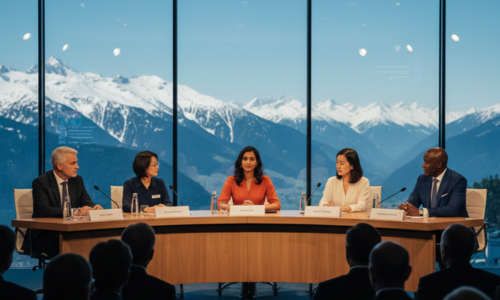
Every global forum now talks about resilience, but for most leaders it still feels abstract. You hear about shocks, polycrises and the need to “build resilience”, while you are simply trying to keep a team focused, a board aligned and a business funded. This article is about turning that big-picture resilience agenda into something you can actually practice.
1. Why everyone is suddenly talking about resilience
In the last few years, global conversations have shifted from efficiency and optimisation to resilience and adaptability. Supply chain shocks, geopolitical risk, climate events and rapid shifts in technology have made it clear that disruption is not an exception; it is now the operating environment. Boards and investors are asking new questions: How quickly can we adapt? How well do we absorb shock without losing trust, talent or momentum?
At the same time, leaders are carrying more personal load than ever: caring responsibilities, health issues, the emotional impact of constant uncertainty, and the pressure to have a considered opinion on everything that happens in the world. Resilience is no longer a “nice to have” leadership trait. It is the bridge between global volatility and everyday decisions about people, capital and priorities.
The World Economic Forum’s Future of Jobs Report 2025 reflects this shift. Employers now rank resilience, flexibility and agility, leadership and social influence, motivation and self-awareness and other human skills alongside analytical thinking as top core skills for the workforce. You can read more in the skills outlook section of the report here .
2. What resilience actually looks like in a leader
Resilience is often mistaken for stamina or grit, the ability to just keep going. In practice, resilient leaders do three different things:
– They absorb shocks without becoming emotionally flooded. They can feel pressure, but it does not spill unfiltered into their decision making or relationships.
– They adapt behaviour and strategy when reality changes, rather than clinging to the original plan because so much has already been invested in it.
– They align others around the new reality, sustaining trust and clarity even when the news is difficult.
Those behaviours are not mysterious. They sit on top of very specific emotional intelligence capabilities that can be measured and developed.
3. The EQ-i 2.0 subscales that build resilience
Within the EQ-i 2.0 framework, several subscales directly underpin resilient leadership:
Stress Tolerance – your ability to remain functional and composed under pressure. Leaders with higher Stress Tolerance are better able to keep thinking clearly while others are overwhelmed.
Flexibility – how easily you can shift your thinking, plans or behaviour when circumstances change. Flexibility is what lets you pivot without losing your core direction.
Optimism – your capacity to hold a realistic belief that things can improve. This is what keeps teams engaged and willing to try again after setbacks.
Reality Testing – your ability to see things as they are, not just as you hope or fear them to be. Without this, optimism turns into denial.
Emotional Self-Awareness – how quickly you can recognise what you are feeling and how it is influencing you in the moment.
The most resilient leaders are not the ones who score perfectly on each of these, but those who understand their pattern—for example high Optimism paired with lower Reality Testing—and design habits and support around it.
4. ORA: translating global resilience into your week
The ORA framework turns this into practice:
Origin – see what is really there. Benchmark yourself against leadership norms with the EQ-i 2.0 assessment. Instead of vague stories like “I am good under pressure”, you get data on how you actually show up.
Resilience – work with how you operate under pressure. Move from scores to behaviours. For example, if Stress Tolerance is strong but Flexibility is lower, you may cope well in crisis but struggle to change course quickly. You design specific practices, like the Impact vs Energy Cost framework or structured recovery rituals, that match your profile.
Alignment – make decisions, money and relationships pull in the same direction. Resilience is not just about how you feel; it is about how you allocate capital, attention and trust. This is where you connect EQ patterns to things like runway decisions, hiring tempo and how you communicate risk to your board or team.
Seen this way, resilience stops being a slogan and becomes a pattern you can observe and influence.
5. Three resilience patterns I see most often
Here are three recurring patterns in senior leaders and founders, and what to work on:
Calm but rigid
These leaders stay composed in a crisis but hold tightly to the original plan. Stress Tolerance is high; Flexibility is lower. The work is to build structured “pause and rethink” moments where new data is genuinely allowed to change the plan, rather than simply being rationalised away.
Flexible but flooded
Others can pivot easily and generate options, but feel emotionally overwhelmed when stakes rise. Flexibility is strong; Stress Tolerance and Emotional Self-Awareness may be lower. Here you focus on noticing early physical and emotional cues, simplifying decision load and building small containment rituals before big conversations.
Optimistic but ungrounded
A third group radiates hope and possibility, which is crucial for engagement, but under-weights risk. Optimism is high; Reality Testing lags. The shift is to institutionalise good questions: “What has to be true for this to work?”, “What would we see first if this were going wrong?”, and to ensure at least one trusted voice in the room is explicitly tasked with stress-testing assumptions.
Each pattern is workable once you can see it. The risk lies in leading on autopilot, believing you are “being resilient”, when in reality your pattern is quietly adding fragility.
6. Building resilience when life is loud
Global volatility is not going away. Neither is the personal load many leaders are carrying. So the practical question becomes: how do you build resilience when your life is already full?
A few starting moves:
- Run an honest audit of your week using the Impact vs Energy Cost lens. Protect one high impact, low energy activity; deliberately drop or delegate one low impact, high energy activity.
- Choose one resilience-related EQ-i subscale you want to experiment with for the next 90 days—Stress Tolerance, Flexibility, Optimism, Reality Testing or Emotional Self-Awareness—and design one simple weekly ritual around it.
- Share your pattern with one trusted colleague or coach. Resilience is easier to build when someone else can say, “This is one of those moments where your optimism or caution is running the show, do we want that here?”
Resilient leadership is not about being invulnerable. It is about knowing your emotional architecture well enough to bend without breaking, and about building organisations where that same capacity is distributed, not hoarded at the top.
Building organisational resilience? ORAlume works with leadership teams to develop EQ-informed resilience practices that translate global volatility into grounded, day-to-day decision-making. Let’s talk about what resilience looks like for your context.